
Anyone who has generated a plant procedurally has met Aristid Lindenmayer without necessarily knowing it. In 1968 he was a biologist trying to describe how algae grow, and what he produced was a formal grammar: a starting symbol, a handful of rewrite rules, and an instruction to apply them again and again. L-systems went on to become one of the foundations of generative art, and the reason procedural trees look convincing is not clever art direction. It is that real plants are, in a genuine sense, running a rule set.
A Rule With No Stopping Condition
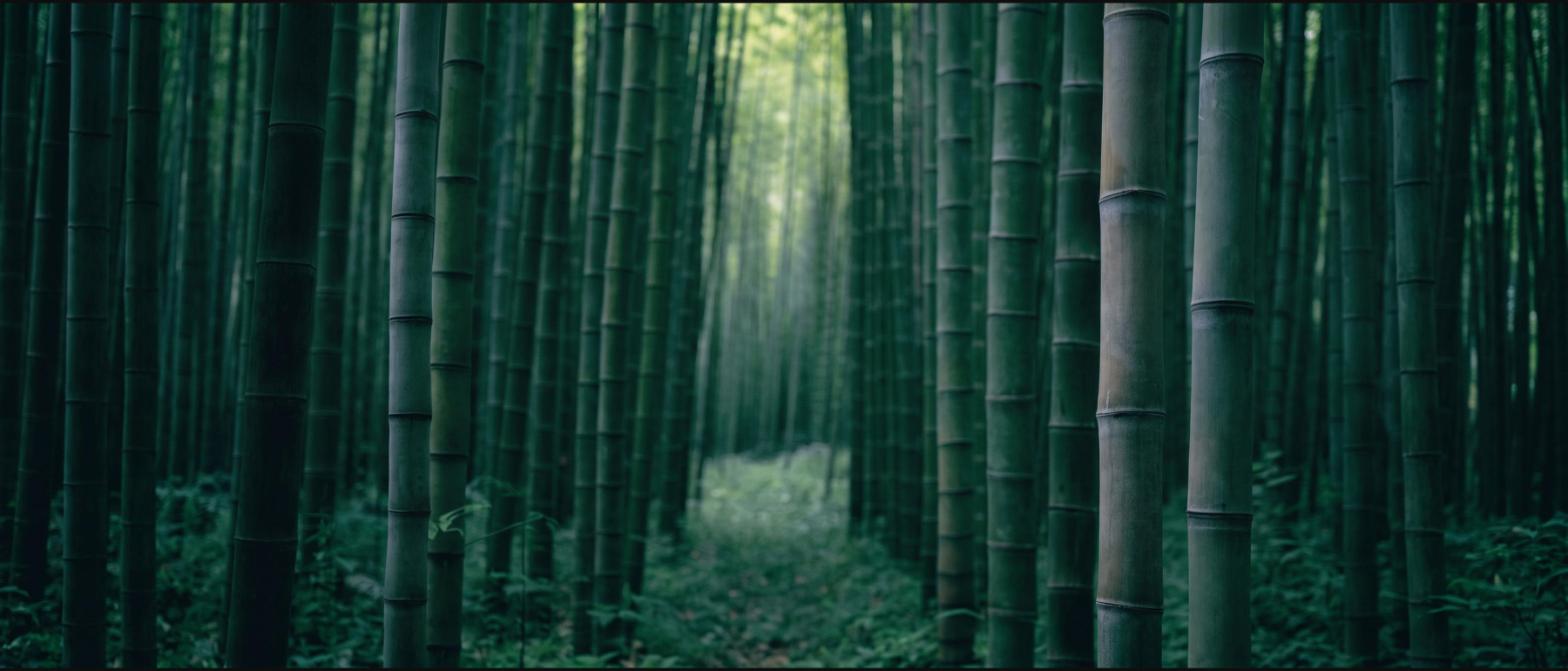
Most plants run bounded rules. A shrub reaches a size its architecture and water budget allow, and stops. Some do not, and bamboo is the clearest case anybody can go and look at.
The rule for a running bamboo is roughly: extend the rhizome horizontally, at intervals either branch or send a shoot upward, then repeat. Written out that way it looks harmless. What it lacks is a depth limit or a bounding box, and a rule without either will eventually produce a result nobody intended. Clumping species run a visibly different rule, one where the rhizome turns upward almost immediately, and the output stays a defined shape.
So when people ask is bamboo an invasive plant, the accurate answer is that it depends entirely on which rule set a given species is running. The genus matters far more than the word “bamboo” does. A few running species are formally listed as invasive in parts of the United States; the clumping ones generally are not.

Watch: Is It Invasive or Not? Running vs. Clumping Bamboo (YouTube)
What the Rule Does to Pavement

You will see photographs of shoots standing up through tarmac and read that bamboo grows through concrete. Worth being precise here, because the truth is more interesting than the myth. Bamboo does not bore through sound concrete. What it does is find a joint, a crack, a gap at the edge of a slab, and then expand there with real force as the shoot thickens. It is an algorithm exploiting an unchecked input rather than brute strength.
The Strangest Line in the Program
The part that should unsettle any programmer is the flowering. Many bamboos flower gregariously: an entire species, including clones planted on other continents, flowers in the same window after an interval measured in decades, sets seed, and then dies. Reported cycles run from roughly forty to over a hundred years. In north-east India the seed glut that follows has historically triggered rat population explosions and famine, on a schedule locals could predict.
A timer with a period longer than most human careers, held somewhere in the plant, synchronised across continents, with no known mechanism that fully explains it. We write scheduled jobs and lose track of them in eighteen months.
Rules We Cannot See the End Of
The appeal of generative work is watching simple rules produce something you did not specify. Bamboo is the same pleasure with the safety rails removed, which is worth remembering the next time you write a recursive function, or plant one.